
What AI cannot do when it comes to understanding human behaviour
 By Nick van der Linden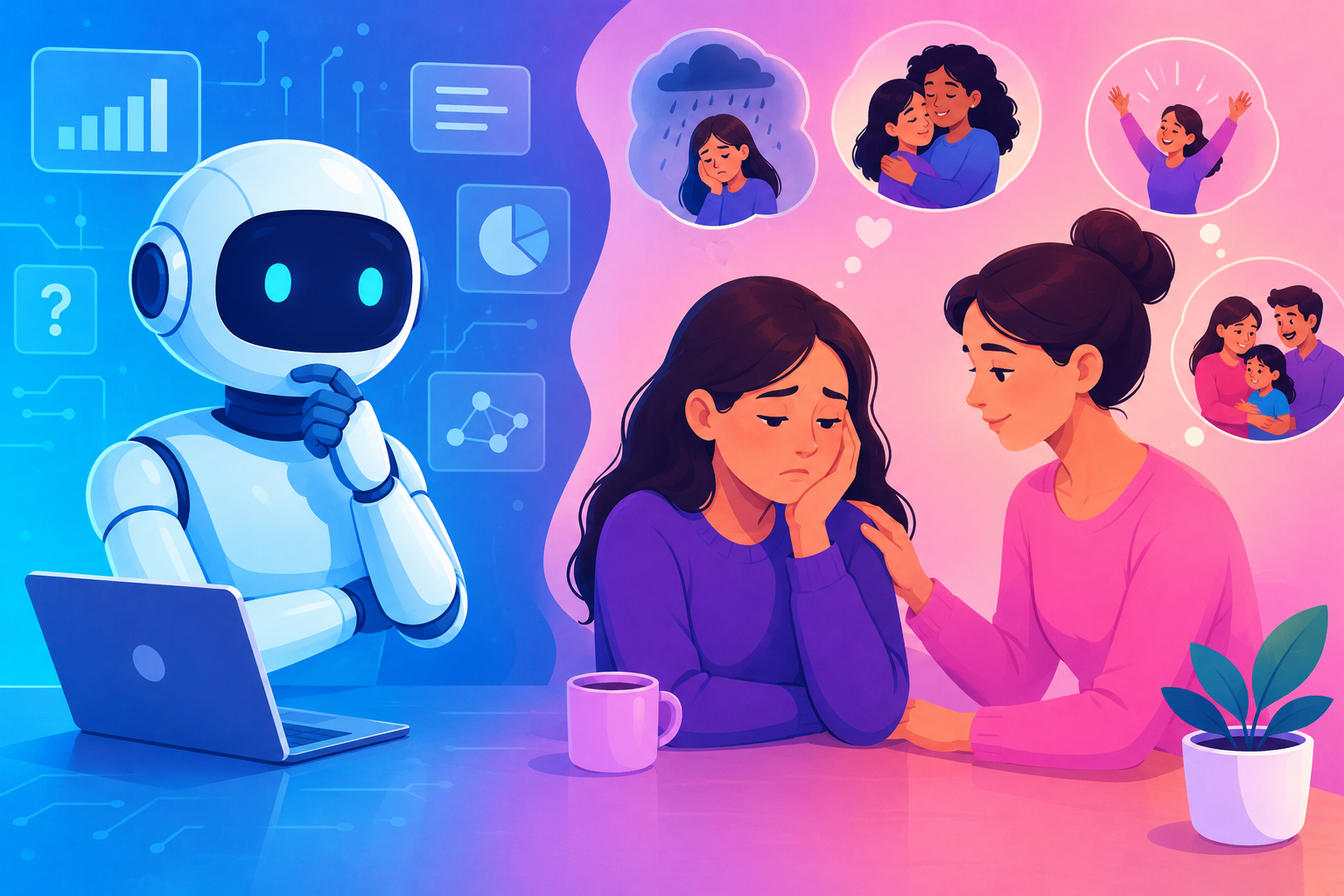
Artificial intelligence can now write poetry, pass medical licensing exams, and hold a conversation that feels, at times, disconcertingly human. It is understandable that people are beginning to wonder what this means for psychology and mental health care. If an AI can mimic empathy, analyse patterns in speech, and respond to distress, does it offer something genuinely useful for people who are struggling? The honest answer is: sometimes, and within very specific limits. Understanding those limits matters, particularly if you are someone trying to make good decisions about your own mental health care.
What AI is actually doing when it analyses behaviour
AI systems that appear to understand human behaviour are, at their core, doing something quite different from understanding. They are identifying statistical patterns across enormous datasets. When a language model responds to a description of anxiety in a way that feels attuned, it is not drawing on lived experience, emotional memory, or clinical judgement. It is generating the most statistically probable response based on patterns learned from billions of lines of text.
This distinction matters more than it might initially seem. Human behaviour is not primarily a pattern-recognition problem. It is shaped by biographical history, relational context, cultural meaning, unconscious processes, and the particular way a person has learned to make sense of the world around them. An AI system can detect that certain words cluster together in descriptions of depression. It cannot understand what a particular person's depression means to them, where it came from, or what it might be protecting them from.
The problem with context
One of the most consistent limitations of AI in psychology-adjacent applications is its difficulty with context, and not just situational context, but the kind of deep personal context that shapes how a symptom or behaviour actually functions for someone.
Take anxiety as an example. Two people can present with almost identical symptoms and have entirely different origins, meanings, and treatment implications. For one person, anxiety might be a learned response to an unpredictable early environment. For another, it might be a feature of an underlying neurodevelopmental profile. For a third, it might be a reasonable response to a genuinely difficult current situation. Distinguishing between these possibilities requires a clinician who can hold complexity, ask precise questions, and integrate information across multiple domains over time.
AI systems trained on symptom checklists and population-level data are not well-equipped to make these distinctions. They tend to work at the level of surface presentation rather than underlying mechanism, and that is precisely where clinical work is most important.
The therapeutic relationship cannot be automated
Decades of psychotherapy research have established that the therapeutic relationship is one of the strongest predictors of treatment outcome, often more predictive than the specific technique being used. A landmark meta-analysis by Norcross and Lambert (2019), drawing on over 50 years of psychotherapy research, found that relationship factors accounted for as much variance in outcomes as the specific treatment model applied. The experience of being genuinely heard, of having a trained clinician hold your distress without being overwhelmed by it, and of working through a real relationship over time, is itself part of how psychological change happens.
This is not something AI can replicate, even with sophisticated conversational design. A language model does not have a continuous relationship with you. It does not carry forward what you shared last week. It does not notice the shift in your tone when you mention a particular person. It cannot use the relationship itself as a therapeutic instrument, because there is no relationship in any clinical sense of the word.
Research published in World Psychiatry in 2023 found that while digital mental health tools showed modest benefits for mild symptoms, effect sizes were substantially smaller than those achieved through therapist-delivered care, and dropout rates were significantly higher. The human element was not incidental to those outcomes. It was central to them.
Where AI tools help and where they do not
This is not an argument against AI having any place in mental health contexts. There are areas where technology genuinely contributes:
- Psychoeducation and information access for people not yet in care
- Symptom tracking between sessions
- Low-intensity support for mild and transient difficulties
- Reducing barriers to help-seeking by offering a low-stakes first point of contact
Where AI tools carry more risk is when they are positioned as substitutes for clinical care rather than supplements to it. Someone presenting with complex trauma, a personality disorder, active suicidality, or a condition requiring differential diagnosis needs a trained clinician. The consequences of an AI system missing a clinical signal, misattributing a symptom, or offering generic reassurance where nuance and challenge are needed can be significant.
There is also an equity concern worth naming. AI mental health tools are disproportionately accessed by people who are already relatively resourced and help-literate. The populations with the greatest mental health need and the least access to care are often not well-served by technology-first approaches, and positioning AI as a solution risks widening rather than closing that gap.
What good psychological care actually requires
In a psychology practice, understanding a person means more than processing what they say. It means noticing what they do not say, how they hold themselves when a particular topic comes up, the patterns that repeat across relationships and across sessions, and the moments when something shifts in the room. It means being a trained human being who can tolerate uncertainty, sit with distress, and offer a response that is shaped by clinical knowledge and genuine presence rather than probability.
It also means being accountable. A psychologist operates within a professional and ethical framework that includes supervision, registration, and ongoing training. An AI tool does not carry professional responsibility for the advice it gives or the harm that might follow from it. That accountability is not a bureaucratic formality. It is part of what makes a therapeutic relationship safe enough to do real work in.
Final thoughts
AI will continue to develop, and some of its applications in mental health will become more useful over time. But the fundamental task of psychology, which is understanding a particular human being in their particular context and working with them to create meaningful change, remains one that requires human presence, clinical training, and a genuine relationship. If you are navigating questions about your mental health and wondering whether an app or an AI tool is a reasonable place to start, it may be a useful first step in some circumstances. It is rarely a sufficient one. If you would like to speak with someone who can actually understand what you are carrying, our team at Contemporary Psychology is always available.