
What Task Switching Does to Your Brain
 By Nick van der Linden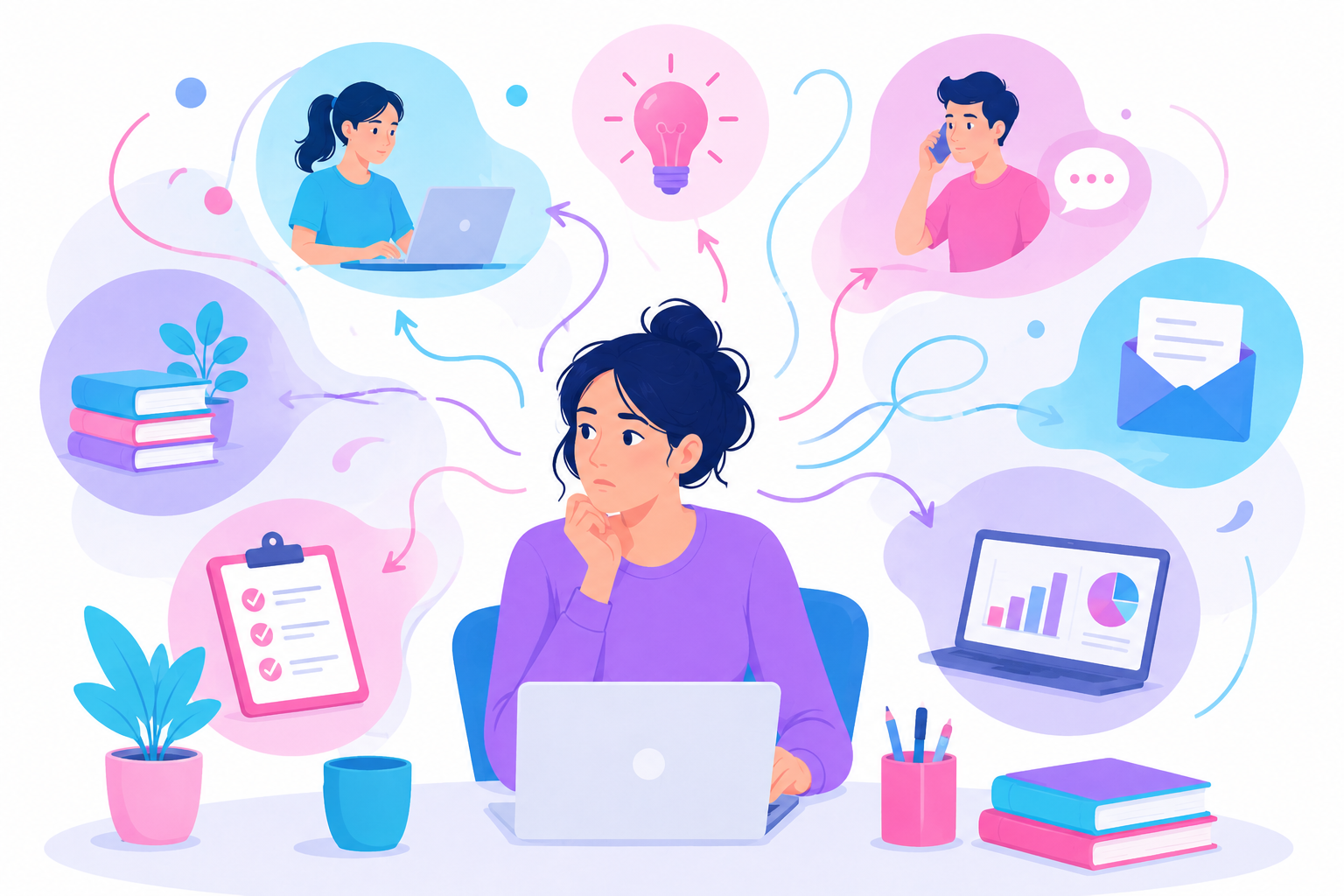
Modern work often rewards responsiveness. Messages arrive constantly, priorities shift throughout the day, and attention is expected to move quickly between tasks.
On the surface, this can feel productive. Multiple things are being addressed at once, and there is a sense of staying on top of demands.
But the brain does not truly multitask in the way many people assume. Instead, it rapidly switches attention between tasks, and this process comes with a cognitive cost.
Over time, frequent task switching can quietly drain mental energy, reduce efficiency, and fragment attention in ways that are difficult to notice in the moment.
The brain is not designed for parallel focus
The prefrontal cortex plays a central role in directing attention, holding goals in mind, and managing working memory. While the brain can process multiple streams of information automatically, deliberate cognitive tasks rely heavily on this limited system.
This means the brain generally focuses consciously on one demanding task at a time.
When attention shifts between tasks, the brain has to
- Disengage from the first task
- Reorient towards the new task
- Load different rules, goals, or information into working memory
Even when these shifts happen quickly, they still require energy and processing resources.
The hidden cost of switching
Each transition between tasks creates what neuroscientists often refer to as a switching cost.
Part of the brain remains temporarily attached to the previous task while another part attempts to engage with the new one. This creates a brief period of reduced efficiency where attention is divided between competing demands.
Individually, these shifts may seem minor. Repeated hundreds of times throughout the day, they accumulate significantly.
This can contribute to
- Slower thinking and reduced accuracy
- Increased mental fatigue
- Greater distractibility
- Difficulty entering deeper states of concentration
The brain spends more energy transitioning than sustaining.
Attention residue and cognitive fragmentation
One reason task switching feels mentally draining is because attention does not reset instantly.
After moving away from a task, part of the brain often continues processing it in the background. Researchers sometimes refer to this as attention residue.
For example, after responding to an emotionally charged email, part of your attention may remain attached to that interaction even while attempting to focus elsewhere.
As unresolved tasks accumulate, the brain carries more residual cognitive load across the day.
This creates a fragmented attentional state where focus feels continuously interrupted, even in quieter moments.
Dopamine and novelty seeking
Task switching is also reinforced by the brain’s reward systems.
Each new notification, message, or task introduces novelty, and novelty increases dopamine activity. The brain becomes rewarded for shifting attention, particularly when the new input feels immediately relevant or stimulating.
Over time, this can condition the nervous system towards shorter cycles of engagement.
The result is that sustained focus begins to feel less natural, while rapid shifts in attention become increasingly automatic.
This does not reflect reduced discipline. It reflects how the brain adapts to repeated patterns of stimulation.
Why deep work feels harder
Sustained concentration requires the brain to remain engaged with one cognitive goal long enough to move into deeper processing states.
Frequent interruptions disrupt this process before the brain fully settles into focused attention.
This matters because deeper focus supports
- More efficient problem solving
- Stronger memory encoding
- Greater cognitive clarity
- A stronger sense of progress and satisfaction
Without sustained attention, work often remains at a more reactive and mentally effortful level.
Stress amplifies switching behaviour
Stress changes how the brain allocates attention.
When the nervous system is activated, attention becomes more sensitive to perceived urgency and interruption. The brain prioritises responsiveness over depth because it interprets rapid shifts as adaptive under pressure.
This can create a reinforcing cycle
- Stress increases attentional fragmentation
- Fragmentation increases mental fatigue
- Fatigue reduces the capacity for sustained focus
- Reduced focus creates more stress
Over time, the brain becomes increasingly practised at scanning and reacting rather than concentrating deeply.
Supporting the brain differently
Reducing task switching does not mean eliminating flexibility entirely. Modern environments often require responsiveness. The key difference is whether attention is constantly fragmented or intentionally directed.
Creating longer periods of uninterrupted focus allows the brain to remain engaged with one cognitive context for longer. Even relatively small reductions in interruption can improve mental clarity and reduce fatigue.
Externalising tasks, batching similar activities together, and reducing unnecessary notifications can also help lower the frequency of attentional resets.
Importantly, the brain tends to function more efficiently when it is allowed to sustain attention rather than repeatedly restart it.
Why this matters
Task switching often feels productive because activity remains high. But activity and efficiency are not always the same thing.
When attention is repeatedly fragmented, the brain spends increasing amounts of energy managing transitions rather than producing meaningful cognitive work.
Understanding this shifts the focus away from doing more simultaneously and towards protecting the quality of attention itself.
Final thoughts
If your brain feels mentally scattered by the end of the day, it may not simply be the amount of work you are doing.
Frequent switching between tasks can quietly overload attentional systems and reduce the brain’s ability to fully engage with any one thing. Creating even short periods of uninterrupted focus can help reduce cognitive fatigue and improve how efficiently the brain works across the day.