blog
The Attention Crisis, How Short Form Media and AI Companions Are Changing Your Brain
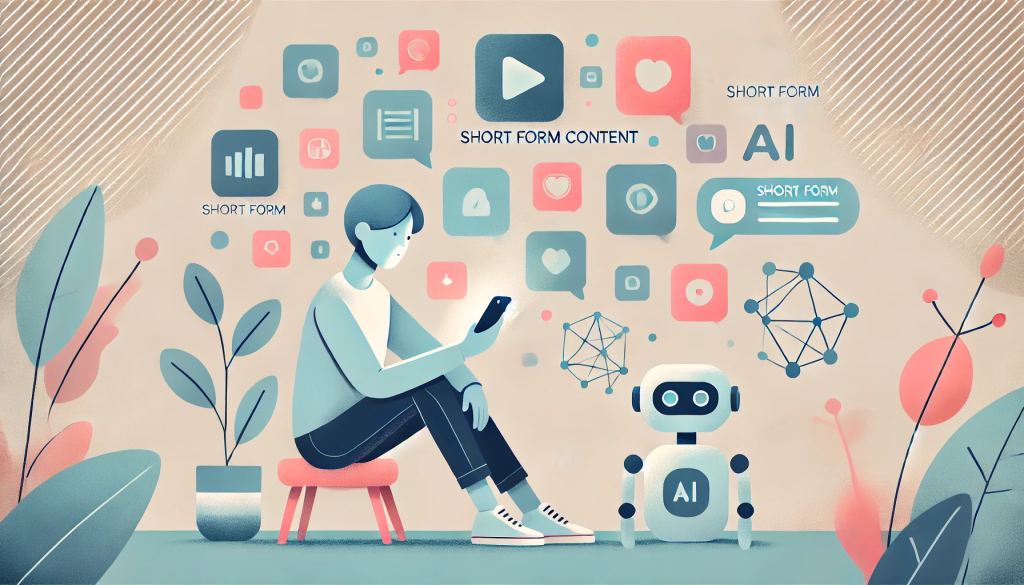
We are consuming more information than at any other point in history. Globally, the average person now spends over two hours per day on social media platforms, with much of that time devoted to short-form video and algorithmically curated feeds. At the same time, artificial intelligence companions are becoming increasingly sophisticated, offering on-demand conversation, validation, and emotional responsiveness. Individually, these technologies appear efficient and harmless. Collectively, they may be altering attention, emotional regulation, and relational development in subtle but meaningful ways.
The cognitive cost of short-form content
Short-form content is engineered for rapid engagement. Videos often last under sixty seconds, with constant novelty, visual stimulation, and emotionally charged hooks. This format capitalises on the brain's dopaminergic reward system, particularly within the mesolimbic pathway. Variable reinforcement schedules, similar to those observed in gambling research, are especially effective at maintaining behaviour. Research published in Nature Communications in 2019 found that collective attention spans around trending topics are narrowing over time, suggesting that the digital information environment may be accelerating the turnover of focus. Experimental studies show that heavy media multitaskers demonstrate poorer performance on tasks requiring sustained attention and cognitive control, and are more susceptible to distraction and less able to filter irrelevant information. From a neuroplasticity perspective, this matters: the brain strengthens the circuits it uses most. If daily cognitive activity is dominated by rapid task switching and micro-bursts of novelty, it is reasonable to expect long-term changes in attentional endurance, with implications for deep work, complex reasoning, and strategic thinking.
Emotional regulation in a high-stimulation environment
Short-form content is not only brief; it is emotionally optimised. Clips often provoke outrage, inspiration, fear, or amusement within seconds. Frequent exposure to emotionally charged stimuli can increase baseline arousal levels and reinforce habitual checking behaviour. Data from the American Psychological Association's 2023 Stress in America survey indicated that nearly half of adults report that social media makes them feel overwhelmed, yet many continue to use it daily. This reflects a reinforcement loop: stress drives consumption, consumption heightens arousal, heightened arousal disrupts sleep and concentration, and reduced sleep further impairs emotional regulation. Sleep research consistently links evening screen exposure and irregular digital engagement with poorer sleep quality, which in turn affects mood stability, impulse control, and executive function. These patterns are explored in more depth in how to disrupt your social media habits and reclaim your agency.
The psychological risks of AI companionship
Parallel to the rise of short-form media is the emergence of AI-driven conversational agents. Apps such as Replika and large language models developed by organisations such as OpenAI are increasingly used for companionship, emotional processing, and simulated intimacy. Loneliness is a significant public health issue, and in this context AI companionship can appear protective: it offers non-judgemental responsiveness, instant availability, and tailored validation. However, human relationships are fundamentally reciprocal and unpredictable. They require negotiation, repair, and perspective-taking, processes that are critical for building emotional resilience, empathy, and secure attachment patterns. The risks are not that AI is inherently harmful, but that exclusive reliance may reinforce avoidance of real-world social exposure, lower tolerance for relational ambiguity, create unrealistic expectations of constant responsiveness, and blur distinctions between simulation and mutual attachment. For individuals with social anxiety or attachment insecurity, this may reduce motivation to engage in more effortful human relationships. The limitations of AI as a substitute for human connection are examined in detail in the dangers of replacing your therapist with AI.
The convergence effect
Both short-form content and AI companionship share core characteristics: they are frictionless, personalised, and optimised for engagement. They minimise boredom, disagreement, and effort. From a behavioural perspective, systems that maximise reward while minimising effort are highly reinforcing. Yet psychological growth often occurs in spaces that are slower and less comfortable. Long-form reading strengthens sustained attention networks. In-person conversations strengthen social cognition and empathy circuits. Unstructured time fosters creativity through default mode network activation. Boredom has been linked in research to increased creative thinking when individuals are allowed to engage in undirected thought. The concern is not technological progress itself; it is the cumulative effect of a cognitive and relational environment dominated by speed, stimulation, and simulated connection.
A deliberate counterbalance
Protective factors are straightforward, though not always easy. Structured periods of deep work without digital interruption, regular engagement with long-form material, boundaries around evening screen use to protect sleep, and intentional cultivation of reciprocal face-to-face relationships all help. Technology can support mental health when used deliberately. It can also erode attentional capacity and relational depth when used passively and excessively.
Final thoughts
In a culture increasingly shaped by algorithms and artificial companions, depth is no longer the default. It is a practice. For cognitive resilience and psychological wellbeing, it may be one of the most important practices we protect. If you would like to explore how digital habits are affecting your attention or relationships, our team at Contemporary Psychology in St Kilda is here to help.