blog
The difference between an ADHD assessment and an autism assessment
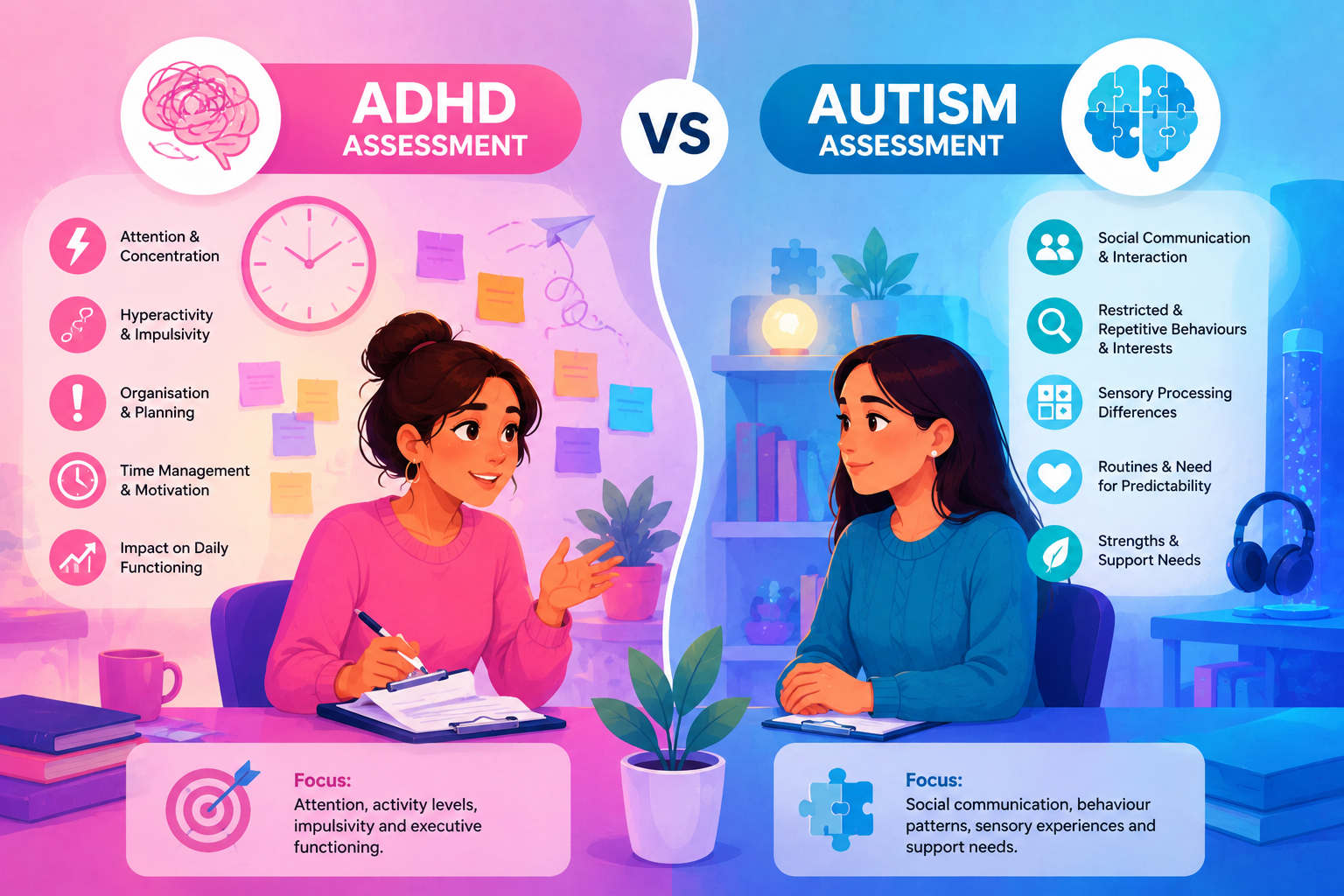
If you have been wondering whether to pursue an ADHD assessment or an autism assessment and are not sure which applies to you, you are not alone. The two conditions share a number of surface features, and for many adults the question of which fits is genuinely unclear before a thorough assessment is done. Understanding what each assessment actually involves, and what each one is looking for, can help you approach the process with more clarity.
What each condition is and how they can look similar
ADHD is a neurodevelopmental condition characterised by difficulties with attention regulation, impulse control, and executive function. It can present as persistent inattentiveness and disorganisation, as hyperactivity and impulsivity, or as a combination of both. In adults, it often shows up as difficulty sustaining effort, managing time, following through on tasks, and regulating emotions.
Autism is also a neurodevelopmental condition, but it is characterised by differences in social communication and interaction, alongside restricted interests and repetitive patterns of behaviour or thinking. Sensory sensitivities are common, as is a strong need for predictability and a particular way of processing the world that does not always align with neurotypical expectations.
On the surface, some features overlap. Both conditions can involve emotional dysregulation, social exhaustion, strong preferences for routine, and challenges in certain work or academic environments. This is one reason self-identification can be unreliable, and why a professional assessment matters more than it might initially seem.
How the assessments differ
While both assessments use clinical interview and validated psychometric tools, the focus and the instruments used are quite different.
An ADHD assessment typically covers:
- Current and historical patterns of attention, impulsivity, and executive function
- How symptoms have presented across different settings over time
- Cognitive profile, particularly working memory and processing speed
- Ruling out other explanations for the presenting difficulties
An autism assessment looks at a broader and somewhat different set of features:
- Social communication and interaction patterns
- Presence of restricted or repetitive behaviours and interests
- Sensory processing differences
- Developmental history, including early childhood
- How the person has adapted or masked over time
An autism assessment typically involves a more extensive developmental history component, and may take longer to complete as a result. Both assessments produce a written report that can be used by GPs, other treating clinicians, workplaces, or institutions such as universities or the NDIS.
Why ADHD and autism so frequently co-occur
Research consistently finds high rates of co-occurrence between the two conditions. Studies suggest that between 30 and 80 per cent of autistic individuals also meet criteria for ADHD, and that a significant proportion of people with ADHD have autistic traits that reach diagnostic threshold. This overlap is not coincidental. Both conditions share genetic underpinnings, and they interact in ways that can complicate the clinical picture considerably.
Attention difficulties in an autistic person, for example, may look different from ADHD-driven attention difficulties, and anxiety or sensory overload can produce symptoms that resemble both conditions without being either. This is why a comprehensive assessment screens for both from the outset, regardless of which one initially brings someone to the process. Beginning with a narrowly scoped assessment can lead to a partial picture that shapes treatment in the wrong direction.
How to decide where to start
For most adults, the most practical starting point is a comprehensive psychological assessment that considers both ADHD and autism together, rather than one scoped to a single condition. This matters because:
- Treatment recommendations differ significantly depending on whether ADHD, autism, or both are present
- Co-occurring conditions are common and change the clinical picture
- Many people are genuinely surprised by what a thorough assessment finds
If you have a strong sense of where your difficulties lie, it is worth sharing that with the assessing psychologist at the outset. Their role is not to confirm what you already believe, but to build an accurate and complete picture of what is actually driving your experience.
Final thoughts
Whether your concerns centre on attention, social connection, sensory experience, or a combination that does not fit neatly into either category, a comprehensive psychological assessment is the most reliable way to understand what is actually going on. At Contemporary Psychology, our adult assessments are designed to capture the full clinical picture, including screening for co-occurring conditions, so that any recommendations we make are grounded in an accurate diagnosis. If you have questions about the assessment process or would like to make an enquiry, you can reach our team directly at contemporarypsychology.com.au.