blog
The Stress-Sleep Cycle: How to Break It Without Overhauling Your Life
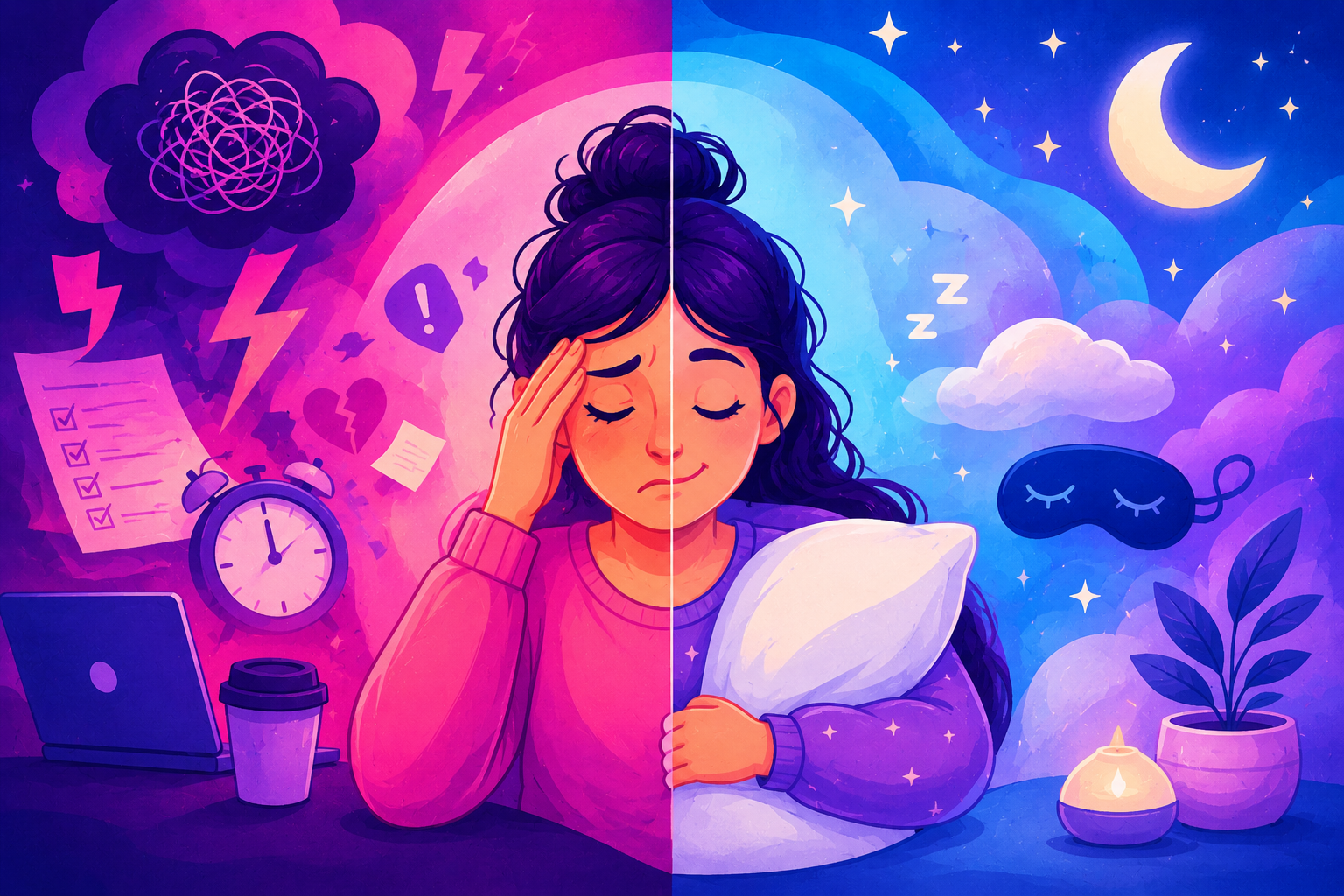
There is a particular kind of exhaustion that does not improve with rest. You lie down tired, your mind keeps moving, sleep comes late or not at all, and you wake the next day less equipped to handle the same pressures that kept you awake. By evening, the whole thing repeats.
This is not just a bad habit or a matter of poor sleep hygiene. For many people, it reflects a genuine loop between stress and sleep that, once established, tends to sustain itself. Understanding how that loop works is the first step to breaking it.
How stress hormones disrupt sleep
Cortisol, the body's primary stress hormone, follows a natural daily rhythm. It rises in the morning to promote alertness and falls in the evening to allow the brain to wind down toward sleep. When stress is chronic, this rhythm is disrupted. Evening cortisol stays elevated, signalling to the brain that threat or demand is still present. Sleep becomes much harder to initiate.
At the same time, the amygdala, the brain's threat-detection centre, becomes more reactive under chronic stress. This is why intrusive thoughts, replayed conversations, and anticipatory worry tend to be worse at night. The brain is scanning for problems, not preparing for rest.
Meanwhile, the prefrontal cortex, which normally helps regulate emotional reactions and bring perspective, becomes less effective when you are sleep-deprived. This makes it harder to manage the very stressors that are keeping you awake. The cycle is neurologically self-reinforcing.
Why trying harder to sleep usually backfires
One of the more counterproductive features of sleep difficulty is that effort tends to make it worse. Sleep is a passive process. It requires the withdrawal of alertness and striving, which is precisely what becomes difficult when stress is high.
Watching the clock, calculating remaining sleep hours, or mentally running through the consequences of another poor night all increase arousal and push sleep further away. This is why psychological approaches to sleep focus on reducing the performance pressure that builds around bedtime, not simply adding more pre-sleep routines.
Creating a real psychological transition into evening
The nervous system responds to context and repetition. When work, screens, and mentally demanding activity continue late into the evening with no transition, the brain has little signal to distinguish night from day. Cortisol stays active and alertness is maintained.
A consistent evening routine does not need to be elaborate. The value lies in its predictability. A reliable sequence of low-stimulation activities trains the brain to associate those cues with winding down. Reading, gentle movement, warm water, and reduced light exposure all work through different physiological pathways toward the same outcome: fewer signals keeping the brain in an alert state.
Passive screen use is worth paying particular attention to here. It tends to feel restful while actually maintaining visual and cognitive stimulation. It is one of the more commonly underestimated contributors to delayed sleep onset.
Understanding sleep pressure and why it matters
Sleep is partly driven by adenosine, a chemical that builds up in the brain across the waking hours and creates a biological drive toward sleep. Caffeine works by blocking adenosine receptors, which suppresses the feeling of tiredness without reducing the underlying accumulation. When caffeine clears later in the day, the adenosine is still there in full force.
Protecting this sleep pressure matters. Napping for more than about 20 minutes during the day can reduce the adenosine-driven urge to sleep at night, particularly for people who already struggle with sleep onset. Keeping a consistent wake time, even after a poor night, helps maintain a reliable sleep drive more effectively than sleeping in on some days and cutting sleep short on others.
Managing racing thoughts and nighttime worry
When ruminative or anxious thinking is a significant part of the picture, the content of those thoughts matters as much as the strategies used to manage them. Scheduled worry time, a practice of setting a deliberate period earlier in the evening to write down and engage with concerns, can reduce how much of that material surfaces at night by partially discharging its urgency beforehand.
For people whose minds fill with incomplete tasks or tomorrow's responsibilities, a short written capture of outstanding items before bed can also help. The prefrontal cortex tends to keep attention on unresolved matters, and writing them down reduces the cognitive load that keeps the brain alert.
Final thoughts on breaking the stress-sleep cycle
The stress and sleep cycle is a genuine neurobiological pattern. Breaking it rarely requires a complete life overhaul, but it does require some clarity about which part of the cycle is most prominent for you, because the most helpful approach will differ depending on whether the main difficulty is getting to sleep, staying asleep, or waking too early.
If sleep difficulty has been present for an extended period and self-directed approaches have not resolved it, working with a psychologist trained in cognitive behavioural therapy for insomnia can offer a more tailored path forward. These are well-understood conditions with well-researched treatments. You do not need to simply wait them out.