blog
The Productivity Trap, When Doing More Starts Costing You More
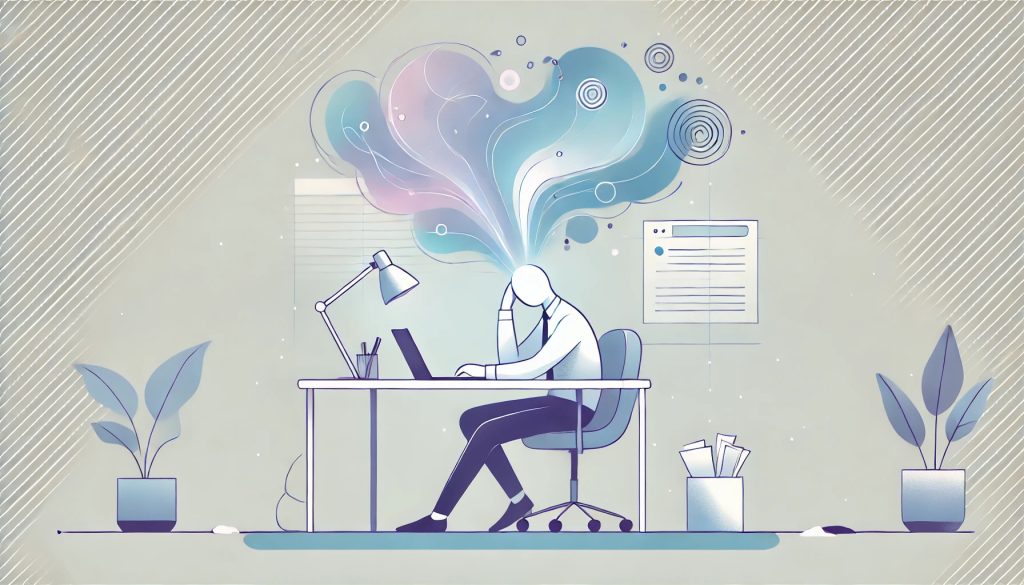
Productivity is often framed as a simple equation: more output equals more success. In most professional environments, doing more is not just encouraged, it is quietly expected. The difficulty is that the brain does not experience productivity in linear terms. At a certain point, increased effort begins to shift from effective to depleting, often without immediate awareness. This is where the productivity trap begins. It does not look like something going wrong. It often looks like competence, reliability, and high standards. But underneath, the cost is accumulating at a neurological level.
When more stops meaning better
Sustained productivity relies heavily on the prefrontal cortex, the part of the brain responsible for planning, decision-making, attention, and self-regulation. It allows you to hold goals in mind, prioritise, inhibit distractions, and sequence complex tasks. The catch is that the prefrontal cortex has limited capacity; it is not designed for continuous, high-intensity output across long periods. It is also highly sensitive to fatigue, stress, and cognitive load. As demands increase, neural efficiency begins to drop, working memory becomes strained, the brain starts to rely more on habitual or automatic responses rather than deliberate thinking, and attention narrows, making it harder to integrate broader context or think creatively. What this feels like subjectively is subtle at first: tasks take longer, you reread information without it landing, small decisions feel heavier than expected, and you rely on pressure or urgency to get things over the line. This is not a motivation problem; it is the brain protecting limited cognitive resources.
The illusion of getting more done
Part of what sustains the productivity trap is how the brain encodes reward. Dopamine is often simplified as the motivation chemical, but its role is more specific: it tracks prediction and progress, increases when something is better than expected, and reinforces behaviours that move you towards a goal. In modern work, this creates an interesting distortion. Completing tasks, clearing emails, ticking off lists all generate small, frequent dopamine signals. Over time, the brain begins to associate movement with reward, regardless of whether that movement is meaningful. You prioritise tasks that are easy to complete over those that require deeper thinking, feel a pull towards clearing rather than creating, and find that being busy feels satisfying even when it is not moving important work forward. The result is a drift towards volume over value.
Cognitive switching and hidden load
Another layer of the productivity trap sits in how attention is used. The brain does not truly multitask when it comes to complex cognitive work. Instead, it rapidly switches between tasks, and each switch requires deactivating one neural network and activating another. This comes at a cost: there is a brief drop in performance as the brain reorients, residual attention from the previous task lingers, working memory is taxed as context has to be reloaded, and error rates increase on complex tasks. Over time, frequent switching leads to a sense of cognitive fragmentation. You may feel constantly engaged, but rarely fully immersed. This is why a day can feel full without feeling productive.
Stress chemistry and the push to keep going
As workload increases, the brain and body begin to recruit stress systems to maintain performance. The release of cortisol and adrenaline can temporarily enhance focus, increase alertness, and mobilise energy. In short bursts, this is adaptive. However, when this becomes the default mode of operating, the brain becomes more reactive and less flexible, the amygdala grows more active, the prefrontal cortex becomes less efficient under sustained stress, and emotional regulation becomes more effortful. This is why productivity under pressure can feel sharp in the moment but costly over time. The system is drawing on future capacity to sustain current output. This pattern is explored in depth in how stress shows up in the body before burnout hits.
When productivity becomes identity
For many high-functioning professionals, productivity becomes more than a strategy; it becomes part of how they understand themselves. At a neural level, this is reinforced through learning and repetition. Behaviours that are rewarded socially and internally become encoded in habit circuits involving the basal ganglia, and over time they require less conscious effort and feel more automatic. A demand or expectation appears, effort and output increase, and completion, approval, or relief follows. When this loop is repeated enough, it starts to feel necessary rather than optional. Slowing down can feel uncomfortable, even when it is needed. This connects to broader questions about why success can feel empty when driven by this kind of pressure.
The shift from output to effectiveness
Moving out of the productivity trap is not about abandoning ambition or lowering standards. It is about aligning effort with how the brain actually functions. From a neuroscience perspective, effective work depends on rhythm rather than constant output. Alternating between focused effort and recovery allows neural systems to reset. Protecting uninterrupted work time supports deeper prefrontal processing. Reducing unnecessary switching preserves working memory and attention, and clear goals reduce ambiguity and cognitive load. Recovery is not just the absence of work; it is the presence of lower-demand states where the brain can shift into networks associated with integration and consolidation. This is often where insight and creativity emerge.
Final thoughts
The productivity trap rarely announces itself clearly. Many people remain highly capable while it is unfolding, and the impact tends to accumulate gradually: reduced clarity and depth of thinking, lower tolerance for stress and complexity, increased irritability or mental fatigue, and a sense of being constantly on without feeling effective. Understanding the underlying brain processes allows for a more precise kind of adjustment, not doing less for the sake of it, but working in a way that preserves the systems that make high-quality work possible. If you would like to explore this further, our team at Contemporary Psychology in St Kilda is here to help.